

















What Is Jean Michel Basquiat Art Style? A Spotlight on the Artist Behind the Iconic Paintings
At first glance, the works of Jean-Michel Basquiat appear chaotic and frenzied. They’re often filled with scribbled words, stick figures, vibrant colors, and symbols that resemble graffiti. However, if you look closer, you’ll find something deeper in his art.
Jean-Michel Basquiat’s work captured the rhythm of New York City in the late 70s and early 80s, a time synonymous with the birth of street culture, punk, disco, and hip-hop. These were the elements that the artist sought to bring to the global art scene, and he did so through his works.
But perhaps the most important aspect of Jean-Michel Basquiat’s artworks is that they tackled issues other artists of the time didn’t dare address, such as race, power, wealth, and the struggles of the Black community. His works forced the global art community to confront issues that the society had ignored at the time.
Although Jean-Michel Basquiat had a short but prolific career, he created hundreds of artworks that redefined the face of modern American art. Today, his pieces are housed in the best museums around the globe and continue to inspire new artists.
In this guide, we’ll discuss who Basquiat was, how his distinctive style developed, and why his work continues to command global attention in the international art market.

Who Is Basquiat?
Early Life of Jean-Michel Basquiat
Jean-Michel Basquiat was born on December 22, 1960, in Park Slope, Brooklyn, New York. His mother, Matilde Andradas, was also from Brooklyn, born to Puerto Rican parents. His father, Gerard Basquiat, was from Port-au-Prince, Haiti. Thus, the young Jean-Michel was fluent in both Spanish and French because of his mixed heritage.
Basquiat was brought up in an artistic environment. His mother often took him to museums like the Brooklyn Museum, where he began studying paintings and absorbing visual ideas that would later appear in his work.
There was one incident that played a crucial role in Jean-Michel’s life, though not directly related to his artwork. At the age of seven, Jean-Michel was involved in a car accident. As a result, he was confined to his bed. His mother gave him Gray’s Anatomy, a book containing diagrams of human anatomy. Jean-Michel was fascinated by these diagrams, and his artwork often featured them.
Basquiat’s life as an artist begins in brief relocations and bold decisions. He became more independent and rebellious, and at the age of fifteen, he ran away from home, choosing the city as his playground and classroom. In 1974, his family moved from New York to Miramar, Puerto Rico, and then, as a teen, Basquiat returned to New York and forged his own path.
At seventeen, he dropped out of school and started earning money by selling handmade postcards with fellow artist Jennifer Stein. He also played in a noise rock band called Test Pattern, later renamed Gray. These were the formative years for the recurring themes that would color the later works of Basquiat.
SAMO Graffiti and the New York Art Scene
Prior to the gallery and museum exhibitions, Basquiat was recognized as a graffiti artist. In the late 1970s, he and his friend Al Diaz spray-painted mysterious sayings all over the lower parts of Manhattan with the tag SAMO, derived from the phrase “Same Old Shit.” They spray-painted these sayings all over the city, including sidewalks and subway stations.
His late teenage years, as described by his roommate in 1979, Alexis Adler, represented Basquiat’s first sense of “having a stable home.” Basquiat, according to Adler, scavenged for materials, such as wood, discarded canvases, and anything else he could get his hands on to create street art. The content of his street art was like poetry or social commentary, and in an era when street artists were often considered vandals, his work caught the attention of artists, musicians, and journalists.
The Lower East Side scene that Basquiat was a part of was alive with creativity. There was a sense of connection between punk rockers, DJs, painters, and filmmakers. Early hip-hop was also emerging, as was experimental art and fashion. Basquiat was part of this scene. He met characters like Glenn O’Brien, a writer, television host, and supporter of Basquiat’s work. Basquiat even appeared briefly in O’Brien’s underground film, Downtown 81, as a young struggling artist.
For a brief moment, Basquiat was a gallery mascot at the Annina Nosei Gallery, sweeping floors and preparing canvases, before eventually becoming one of the gallery’s main artists.
Breakthrough Into the Art World
Basquiat’s rise in the art industry was meteoric and almost cinematic. In 1981, art critic René Ricard wrote the iconic article for Artforum, “The Radiant Child,” celebrating Basquiat’s untapped potential and launching him into the larger art world. From then on, the downtown scene dubbed him the Radiant Child.
Soon after, Basquiat’s first one-man show debuted at Annina Nosei Gallery in a solo exhibition in New York in March of 1982. That same year, the Swiss art dealer for the Galerie Bruno Bischofberger, based in New York, began representing Basquiat on the global stage, providing him access to the global art world.
At just 21, Basquiat achieved the distinction of being the youngest artist invited to participate in the prestigious Documenta exhibition in Kassel, Germany. Basquiat’s rise was meteoric, going from painting on the street walls to selling his works for thousands of dollars on the global stage within a few short years.

What Is Jean Michel Basquiat’s Art Style?
So, what exactly is Basquiat’s style? Basquiat’s works are a mix of graffiti art, poetry, history, and brushstrokes that are both messy and purposeful. His work is rooted in Neo-Expressionism but also reflects the rhythm of jazz, hip-hop, and the street’s visual language.
Neo-Expressionism
This art movement emerged in the late 1970s, as Basquiat returned to bold, expressive painting after a period when minimalism and conceptual art dominated. His Neo-Expressionism had the following characteristics:
-
Raw, energetic brushwork
-
Rough, sculptural figures
-
Multilayered, textured surfaces
His work wasn’t about realistic art but about pieces that look spontaneous and alive. This is why critics have compared his art to jazz music, because it’s unconventional at first glance but has a strong structure beneath the surface.
Graffiti Influence in Basquiat's Art
Though graffiti had no significant impact on Basquiat’s work, his art still reflects its presence. This is because his pieces resemble a graffiti wall, with scribbles, arrows, symbols, and diagrams all over.
Text is a dominant feature in Basquiat’s artwork. He even went so far as to strike out words because it forced the viewer to examine the work more closely. These textual elements became part of the artwork, functioning like a puzzle or a code that invites interpretation.
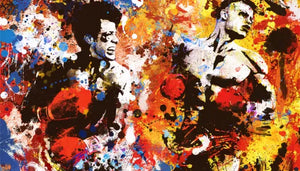
Today, art collectors and artists exploring Neo-Expressionism are drawn to bold, expressive canvas prints, such as graffiti wall art or large-scale abstract canvases that echo the same raw intensity.
Modern artists have also embraced Basquiat's art style in canvas art prints, such as the Basquiat Tribute, Jazz Club Basquiat Style, Big City Love, and See No Evil, to pay homage to the unique style of the legendary artist.
Raw Energy and Visual Chaos
While Basquiat’s works may seem chaotic at first, they’re, in fact, highly ordered and rhythmically composed. He used repetition, stacking crowns, skulls, diagrams, maps, and symbols. He juxtaposed them to portray conflicts, such as wealth and poverty, power and oppression, and fame and marginalization. Basquiat's art focused on the complexity of the world around us, reflecting his experience as an upcoming African American artist in New York City.

Materials and Techniques in Basquiat's Work
Mixed Media and Unconventional Materials
While Basquiat worked within the traditional medium of painting, he often mixed different materials and techniques, such as spray paint, acrylics, oil sticks, and oil paint, making his works multidimensional and textured.
Basquiat also worked on unconventional materials such as doors, wooden boards, and construction materials. He also used Xerox copies of his drawings and stuck them onto his canvases, which made his works visually layered and multidimensional, reflecting his raw, textured style.
Text and Language in Basquiat's Art
Basquiat’s works are dominated by text in the form of historical references, lists of names, cultural commentary, and sometimes simple, random words and phrases. Words and texts are scattered across the canvases, making his art look like coded messages, replete with numbers, arrows, copyright symbols, and written words
The Influence of Human Anatomy
Basquiat was fascinated by the human form, an interest that began with the book Gray’s Anatomy. Inspired by it, he often depicted human skeletons, internal organs, and exposed bones. He used these symbols to portray vulnerability, disintegration, and the oppression and dehumanization of Black people in America.
Symbols and Meaning in Basquiat’s Art
Jean-Michel Basquiat sought and enjoyed unlikely collisions of imagery and words, massive influxes of information and stimuli that recreated the experience of being in a world. The following are some of the symbols he used and their meanings:
The Famous Crown Symbol
The crown is the most popular symbol used by Jean-Michael Basquiat. It has three peaks that symbolize the elevation of musicians, athletes, and historical figures to a state of glory, portraying them as heroes. The crown also symbolized the greatness of the Black people, who were being ignored and forgotten by society.
The Black Skull Motif
The second popular symbol is the Black Skull. He features this in most of his popular works, incorporating elements of both the anatomy of the skull and the mask, which is popular in African art.
Historical and Cultural References
Basquiat’s paintings contained many references to jazz musicians, athletes, historical figures, and political events. His paintings also contained themes of wealth and poverty, issues that Basquiat was familiar with as a Black man who had achieved fame in a predominantly white art world.
Basquiat’s paintings also referenced violence perpetrated by the police. One of these incidents was the death of a young black graffiti artist named Michael Stewart, who was beaten by New York City transit police. Basquiat was clearly moved by this incident, as evidenced by his artwork.

Basquiat, Andy Warhol, and the 1980s Art Scene
Collaboration With Andy Warhol
In 1983, Basquiat collaborated with renowned artist Andy Warhol. Together, Basquiat and Warhol created dozens of collaborative paintings. One of these was a series of eight paintings, each featuring Basquiat’s paintings over Warhol's printed logos. The partnership produced more than 160 paintings, combining Warhol’s bold commercial imagery with Basquiat’s expressive figures, handwritten text, and graffiti-inspired marks.
Their collaboration blurred the boundaries between pop art and neo-expressionism, drawing attention across the New York art world. Art historians now view the collaboration as a significant moment in 1980s contemporary art, highlighting how two very different artistic voices shaped the visual language of painting.
Cultural Impact of the 1980s Art Movement
The 1980s were a decade of cultural change in New York. Basquiat, along with other artists like Keith Haring, marked a new era of blurring the lines between street culture and gallery culture. Basquiat lived between worlds, and his artwork reflected that moment in history when new art emerged from the margins of society.
Why Basquiat's Art Is So Valuable Today
Influence on Contemporary Artists
The influence of Basquiat’s art didn’t end during his time. Artists like Banksy and Shepard Fairey have recognized the impact of Basquiat on the art world. He opened the door for many artists who followed his lead in exploring contemporary art.
Art historian Robert Storr named Basquiat’s style of combining painting and hip-hop as ‘Eye-rap’ because it’s “a unique visual language that bears startling visual syncopation”.
Basquiat in the Global Art Market
Basquiat’s reputation has grown dramatically since his death. In May 2017, his 1982 painting Untitled (Skull) sold for $110.5 million at Sotheby’s auction in New York, purchased by Japanese collector Yusaku Maezawa. The sale set a record for the highest price ever paid for a work by an American artist at auction and reflected the continuing demand for Basquiat’s paintings in the international art market.
Museums internationally are acquiring Basquiat’s art, while collectors are vying for the limited number of his paintings. Basquiat died in 1988 at the age of 27 and was buried in Green-Wood Cemetery in Brooklyn. Despite his short life, Basquiat's contribution to modern art remains immense.
Frequently Asked Questions
What Is Basquiat's Art Style?
Jean-Michel Basquiat is recognized for his contributions to Neo-Expressionism, a movement that revived the tradition of strong, dynamic painting in the 1980s. As a young Black artist in the New York City scene, he used graffiti, text, symbols, and dynamic brushwork. At the same time, his work offered a strong commentary on race, power, and history relevant to the 1980s. Today, institutions like the Whitney Museum still display his work as an example of this period.
What Makes Jean-Michel Basquiat's Art Unique?
Basquiat’s work stands out because it mixes multiple forms of expression into one painting. He used graffiti, poetry, history, and symbolic elements to create a unique visual language. His paintings often explore themes connected to the African American experience and the wider African diaspora, while also challenging the traditions of the New York art world. Through repeated visual motifs such as crowns, skulls, and arrows, Basquiat created artworks that function as both storytelling and contemporary critique.
What Techniques Did Basquiat Use?
Basquiat employed a variety of techniques. He used acrylics, spray, and oil paint, as well as oil sticks, on surfaces such as canvas, wood, and even doors. He also used collage elements, such as Xeroxed drawings glued to the surface of the work. This technique allowed for the fusion of images, text, and symbols to create a dynamic work of art.
What was Basquiat's Visual Language?
Basquiat's visual language features symbols, text, and diagrams. His paintings often include text, arrows, numbers, and drawings of the human body. These elements combine to create a coded language. The viewer is encouraged to study the artwork to decipher the rich history, culture, and experience embedded in each piece.
Did Basquiat have Children?
No. Jean-Michel Basquiat didn’t have any children. At the height of his career in the 1980s, he focused intently on his work. Though he had several important relationships, he never married or had children.
What Does Basquiat’s Crown Symbol Mean?
The crown, one of Basquiat’s favorite symbols, appears frequently in his paintings, often seen adorning the heads of various icons, including musicians, athletes, and even historical figures. It represents honor, power, and prestige. Basquiat often incorporated this symbol into his paintings to celebrate African-American icons and acknowledge the achievements of the African diaspora.
Why Did Basquiat Use Anatomy Dawings?
Basquiat’s interest in anatomy began after a childhood accident when he read the medical book Gray’s Anatomy. The illustrations inspired the anatomical sketches and skeletal imagery that appear throughout his work. These images often symbolize vulnerability, identity, and the fragmentation of the human body.
What are Basquiat’s Most Famous Paintings?
Some of his most famous pieces include Untitled (1982), Hollywood Africans (1983), Untitled (Skull), and Irony of Negro Policeman (1981). These paintings are part of various museum collections and are exhibited at institutions such as the Whitney Museum.
How Did Basquiat Die?
Jean-Michel Basquiat died of a heroin overdose on August 12, 1988, at the young age of 27. His death brought an end to his brief, yet remarkable, career that revolutionized modern art. His legacy lives on, touching the lives of many artists, scholars, and collectors worldwide.
Conclusion
It took Basquiat less than ten years to revolutionize modern art. His paintings mix street art, hip-hop, and history, and challenges traditional modern art. Today, Basquiat’s legacy lives on through modern artists, designers, hip-hop culture, and collectors worldwide. His artwork represents his pure honesty, with paintings alive with color, words, and symbols that command attention. Modern wall art often feature vibrant colors, fonts, and abstraction reminiscent of Basquiat’s style.